
INTERNAL BUILDONGOING
Internal build · ongoing
Turning ahshagar.com signals into traceable growth decisions—not a passive dashboard.
This internal project defines the source validation, normalization, opportunity logic, reviewed brief, and experiment loop needed to connect search, content, and lead evidence safely.
Evidence status: Ongoing internal build. Public views will use aggregated first-party data; low-volume and sensitive records remain private.
Context
The website contains years of SEO content, new system/service architecture, and a future lead workflow. The observatory makes the migration measurable while demonstrating AH Shagar’s combination of search, analytics, automation, and infrastructure.
Low-volume or sensitive data should be aggregated privately. Public proof should focus on the system’s validation, traceability, and time savings rather than exposing business or lead details.
Baseline to capture
- Time required to assemble the current weekly/monthly report
- Sources and manual exports used
- Existing Search Console/GA4/CRM definitions and known discontinuities
- Percentage of leads with valid origin/offer/source information
- How tracking failures are detected today
- Whether recommendations receive owners and later outcome review
Architecture
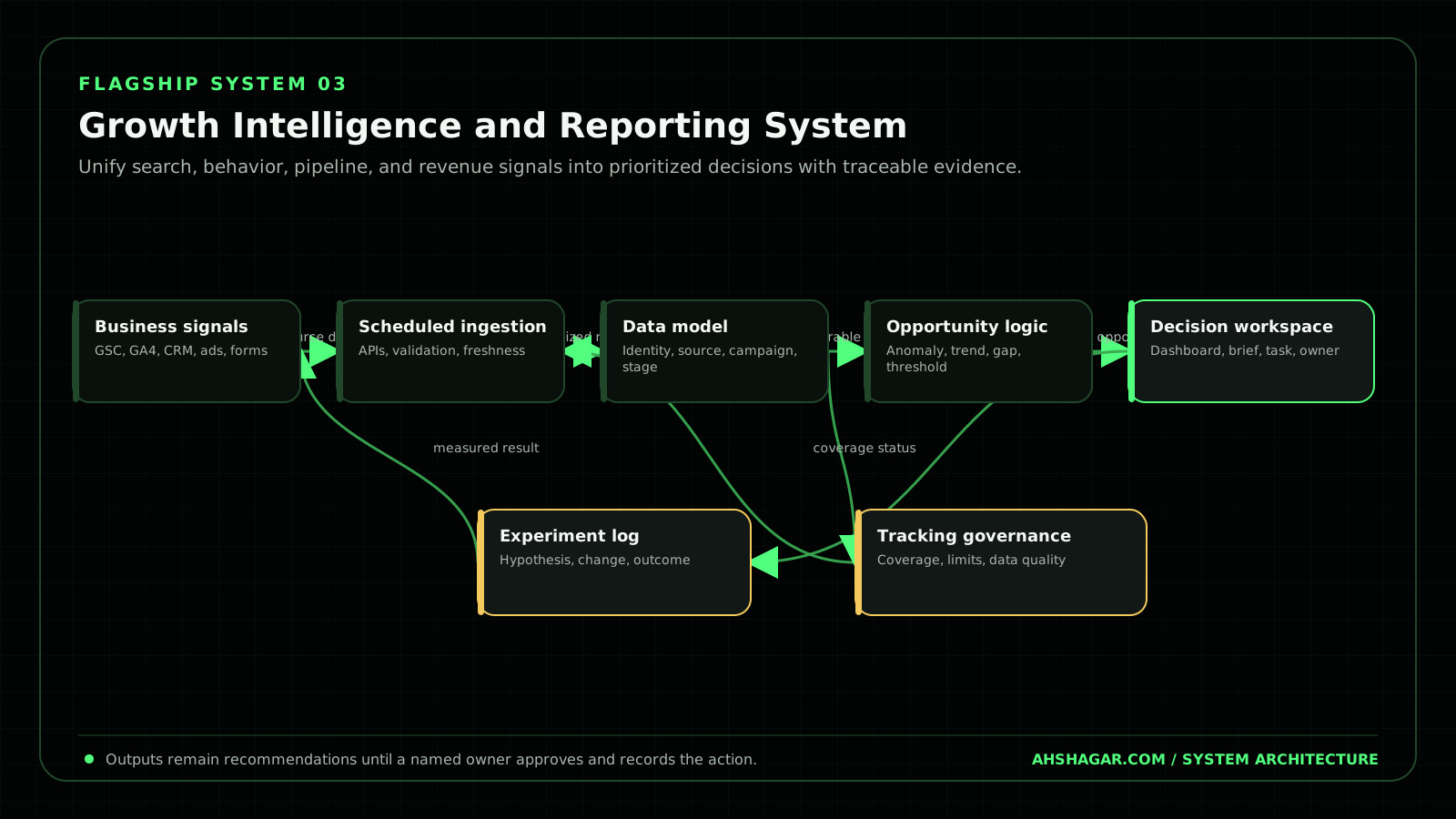
Minimum viable source model
- Search Console: date, query, page, country/device where volume/privacy allows, clicks, impressions, CTR, position
- GA4: date, canonical landing page, source/medium/campaign, engaged sessions, agreed key events; no public user-level export
- Content inventory: URL, type, system/service/project relation, publish/modified date, indexability, canonical, status
- Lead operations: anonymized event ID, origin path, offer, accepted/qualified/booking/ opportunity outcome, timestamps; no public PII
- Experiment log: hypothesis, page/workflow, owner, change, baseline, target, dates, status, result, interpretation
Start with available sources. The project remains useful if CRM outcomes are initially absent; the missing data is shown as a limit and a tracking backlog.
Required data-quality controls
- Last-successful-load and expected-source-delay indicators
- Schema/field presence and type validation
- Row-count and null-rate change thresholds
- Duplicate key checks
- Canonical URL normalization and redirect mapping
- Campaign/source dictionary and
unknownrate - Definition version for conversions and CRM stages
- Backfill and replay behavior
- Source reconciliation notes rather than forced equality
Opportunity rules to demonstrate
Each result must include source link, observation window, comparison, threshold, confidence/ limit, recommended action, and owner.
- Page/query impression growth with declining or weak CTR
- Valuable query cluster with no suitable system/service/project page
- Landing-page engagement or lead progression drop after a release
- Published commercial page missing internal proof links
- Key page removed from sitemap/indexability/canonical consistency
- Lead origin completeness below threshold
- Source pipeline stale or materially different from expected volume
- Existing high-impression legacy content with a relevant new System conversion path
Weekly brief contract
The brief has five sections:
- Source health: freshness, tracking, and definition changes
- What changed: observed values with links and comparison window
- What it may mean: explicitly labeled interpretation
- What to do: proposed action, owner, effort, expected signal, and risk
- What happened to prior actions: status and measured result
AI may draft sections 2-4 from structured facts. A person approves the brief; the generated text cannot publish a website change automatically.
Required test scenarios
- Successful incremental ingestion for each source
- Exact-period replay without duplicate facts
- Missing field/schema change
- Stale source
- Unexpected row-count drop/spike
- Broken canonical/redirect mapping
- Unknown campaign/source increase
- GA4/Search Console totals that legitimately do not match
- One true synthetic opportunity fixture and one non-opportunity control
- Brief containing a fact, inference, source link, and human approval
- Task/experiment creation and later result review
- Analytics/CRM source outage without corrupting prior dashboard state
Acceptance criteria
- Dashboard visibly shows last successful refresh and definition/version notes.
- Known fixture totals reconcile after replay.
- Stale/broken sources alert and do not appear current.
- Opportunity rules do not fire on the control fixtures.
- Every brief observation links to an underlying view/source.
- Facts and interpretations are separately labeled.
- No task or site change is created without the configured human review.
- Public screenshots contain no PII and suppress low-volume sensitive detail.
Evidence required for completed status
- Source health/freshness panel
- Normalized page/query/lead model (redacted)
- Opportunity with source link and transparent threshold
- Tracking-failure alert and stale dashboard state
- Weekly brief before and after human approval
- Experiment record with hypothesis, owner, and result state
- Captioned demo of source-to-action loop
Current limitations
- Search, analytics, CRM, and advertising sources have different delays and attribution rules.
- Early AH Shagar volumes may be insufficient for strong statistical inference.
- The system finds signals and improves decision traceability; it does not guarantee a successful experiment.
- Historical gaps cannot always be reconstructed.
Next step
Turn your recurring report into an evidence-linked operating rhythm.
Bring the current process, tools, approximate volume, and result that matters. The first conversation will identify the smallest useful next step.